
About Kastamonu
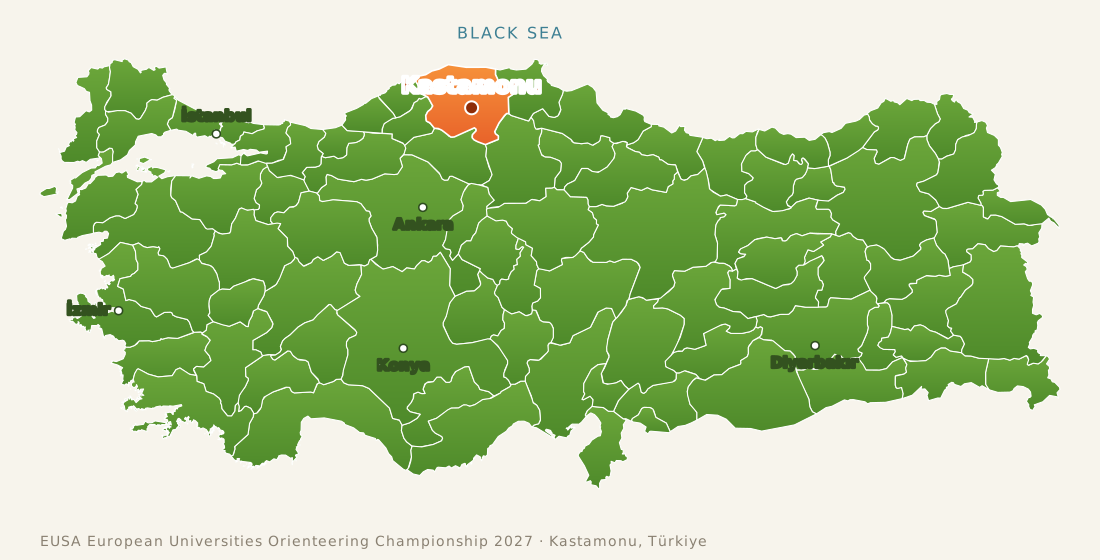
Kastamonu is located in the northern part of Türkiye, in the western Black Sea region, roughly 240 km (150 miles) north of the capital Ankara. The city sits at around 800 metres above sea level in the wide valley of the Karaçomak River, cradled between the forested Küre Mountains to the north — which descend toward the Black Sea coast — and the Ilgaz Mountains to the south.
As the capital of Kastamonu Province — home to roughly 380,000 people, with about 130,000 living in the city itself — Kastamonu is one of Anatolia's most historically layered yet least crowded destinations. More than half of the province is covered in forest, giving it a green, mountainous character that makes it a natural home for outdoor and orienteering sport.
Historical Background
The name "Kastamonu" is widely believed to derive from Castra Comneni — "the fortress of the Komnenos" — after the fortified residence built here by the Byzantine Komnenos dynasty around the 10th–12th centuries. Its castle still crowns the highest point of the city today.
Human settlement in the region reaches back to the Paleolithic era, and over the millennia Kastamonu has been home to the Gasgas (Kaska), Hittites, Phrygians, Lydians, Persians, Romans and Byzantines. With the arrival of the Seljuks in the 11th century it entered the Turkish-Islamic world, later serving as the capital of the Çobanoğulları and Candaroğulları (Jandarid) beyliks — a golden age that produced many of its finest mosques and complexes. In 1461, Sultan Mehmed II definitively incorporated Kastamonu into the Ottoman Empire.
In the modern era, the city holds a special place in the story of the Turkish Republic. During the War of Independence (1919–1922), the İstiklal Yolu (Independence Road) ran from the Black Sea port of İnebolu through Kastamonu to Ankara, carrying smuggled munitions to the front lines. And in August 1925, it was in Kastamonu that Mustafa Kemal Atatürk delivered his famous "Hat Reform" speech — a landmark moment in the young republic's modernization.
A Living Museum of Ottoman Architecture
If Kastamonu has a signature, it is the more than 400 preserved Ottoman-era mansions (konaks) that line its old town. Characterized by overhanging upper floors, intricate woodwork and individually designed façades, these houses cluster along the slopes of the Karaçomak valley — many now restored as boutique hotels, museums and cafés.
At the heart of the city, Nasrullah Square and its 16th-century mosque form a lively gathering point surrounded by historic bazaars, inns (hans) and the two-arched Nasrullah Bridge. Landmarks such as the İsmail Bey Complex, the Şeyh Şaban-ı Veli Complex, the Clock Tower, and the ancient city of Pompeiopolis near Taşköprü trace the Roman, beylik and Ottoman layers of the city's past. In 2018, Kastamonu was named the Cultural Capital of the Turkic World in recognition of this heritage.
Nature and Terrain
For an orienteering championship, Kastamonu's greatest asset is its landscape. Forests cover well over half of the province, and the region is framed by two national parks: Ilgaz Mountains National Park to the south, crowned by Ilgaz peak at 2,587 m, and Küre Mountains National Park to the north, a protected area of deep gorges and rich biodiversity. Dramatic canyons such as Valla and Horma, waterfalls, high plateaus and pine-covered hills give the terrain the varied relief and runnable forest that competitive orienteering thrives on — all within a mild, temperate climate.
Modern Kastamonu
Today Kastamonu blends its heritage with the energy of a growing university city. Kastamonu University, founded in 2006, brought a wave of students and revitalized the local economy, while the reopening of Kastamonu Airport in 2013 — with regular flights to Istanbul — has made the city far more accessible. Its compact, walkable centre, welcoming atmosphere and reputation for warm hospitality, along with a celebrated regional cuisine (from pastırma to etli ekmek and çekme helva), make it an ideal host for an international sporting event.
General Information
Language: The official language is Turkish. English is commonly spoken in academic, tourism and university settings. Locals are also known throughout Türkiye for their distinctive, warm regional accent.
Time zone: Türkiye Time (TRT), UTC+3 year-round. Türkiye does not observe daylight saving time.
Visa: Türkiye is not part of the Schengen Area, so EU/Schengen visa rules do not apply. Requirements depend on your nationality; many visitors travel visa-free or use the official e-Visa system (evisa.gov.tr). Please check the requirements for your country well before travelling.
Currency and exchange rates: The official currency is the Turkish Lira (TRY, symbol ₺). Approximate rates as of mid-2026 (these fluctuate — please check closer to your trip):
1 EUR ≈ 53–54 TL
1 USD ≈ 46–47 TL
1 GBP ≈ 62–63 TL
1 CHF ≈ 57–58 TL
Cash vs card: Card payments are widely accepted in the city, but it is wise to carry some cash for small purchases, bazaar shopping, and rural areas near the competition venues.
Average temperature and expected weather during the championship: Kastamonu enjoys warm, largely clear summers, moderated by its altitude and surrounding forests. In the expected competition period (July), typical conditions are:
Daytime highs: around 26°C to 28°C (79°F to 82°F)
Nighttime lows: around 12°C to 15°C (54°F to 59°F)
July is one of the sunniest and driest months of the year, though brief afternoon showers or thunderstorms are possible — light rain gear is worth packing. Mornings and evenings out in the forest can feel noticeably cooler than in the city centre.
Phone code (calls from abroad): +90
Exit code (international calls from Türkiye): 00
Emergency number: 112 — Türkiye's single, unified number for police, fire, ambulance and all emergencies. Operators in Kastamonu can assist in Turkish, with English support available in many cases.